
Updated by Faith Barbara N Ruhinda at 1120 EAT on Tuesday 7 July 2026
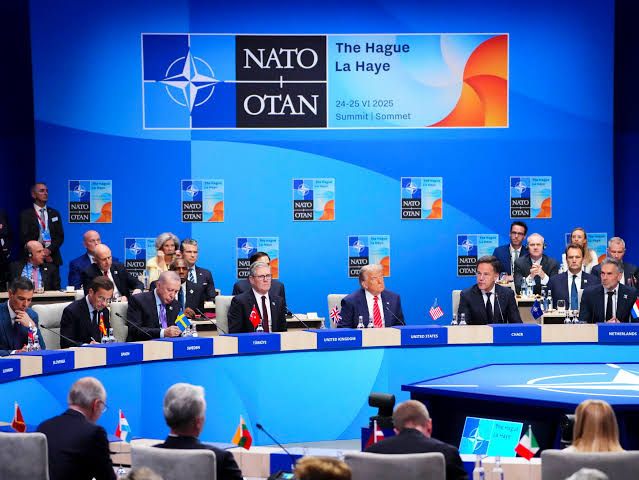
NATO leaders are meeting in Ankara, Türkiye, on Tuesday and Wednesday for a summit expected to focus on defence spending, security challenges and the future of the alliance.
The meeting comes as US President Donald Trump renews pressure on member states to increase their defence contributions. In response, European allies are expected to announce billions of dollars in new military investments and defence contracts aimed at strengthening NATO’s capabilities.
At last year’s NATO summit, member states agreed to raise the alliance’s defence spending target to 5 percent of gross domestic product (GDP) by 2035.
The new commitment includes allocating 3.5 percent of GDP to core military spending, while an additional 1.5 percent will go towards security-related areas such as infrastructure, cybersecurity and defence support measures.
Leaders from all 32 NATO member states are attending the summit in Türkiye this week.
The meeting will also be attended by two leaders from countries outside the alliance: Ukrainian President Volodymyr Zelenskyy and South Korean President Lee Jae-myung.


Australia, Japan and New Zealand are represented by their defence or foreign ministers, while Gulf states affected by the US-Israel war on Iran — Bahrain, Kuwait, Qatar and the United Arab Emirates — are also sending senior officials.
Syrian President Ahmed al-Sharaa is not expected to take part in the NATO summit but is scheduled to hold a separate bilateral meeting with US President Donald Trump in Ankara.
US President Donald Trump has questioned NATO’s value since his first presidential campaign, arguing that the United States has carried an unfair share of the alliance’s financial burden. At the time, only five NATO members were meeting the agreed target of spending 2 percent of GDP on defence.
His repeated calls for greater burden-sharing have contributed to increased defence commitments among member states in recent years, with allies pledging to raise military spending.
Ozgur Unluhisarcikli, the German Marshall Fund’s regional director for Türkiye, said this year’s summit is expected to focus on turning those commitments into practical military capabilities.
“NATO allies just decided to increase their defence spending to five percent last year at The Hague, and European allies took action to upgrade their defence industries,” he said. “This year in Ankara, the discussion will be on how to translate spending into capabilities. It is therefore stronger than it was last year.”
Paolo von Schirach, president of the Global Policy Institute, cautioned that the benefits of increased defence spending would take time to materialise, noting that higher budgets do not immediately translate into stronger military capabilities.
“More orders mean more military hardware, but only eventually,” he said. “You can spend a lot and obtain not too much.”
What Ukraine needs from the summit
Ukrainian President Volodymyr Zelenskyy is set to hold a bilateral meeting with US President Donald Trump on Wednesday on the sidelines of the summit. Ukraine is not a member of NATO.
Zelenskyy is expected to use the meeting to seek additional Patriot air defence systems as Russian strikes on Ukrainian cities intensify. A drone attack on Kyiv on Monday morning killed at least 11 people.


Jack Watling, a senior research fellow at the Royal United Services Institute, said Ukraine is seeking continued political and military support from NATO members to demonstrate to Russia that allied backing will remain strong.
The aim, he said, is “to show Russia that there will be no diminution in its defensive capacity over the next 12 to 24 months”.
“There is a direct correlation between the number of interceptors supplied to Ukraine and the damage that Russia can inflict with ballistic missiles,” Watling said.
The billions of dollars in defence contracts expected to be announced by European countries at the summit are viewed by some analysts as an effort to address concerns from the Trump administration over NATO’s burden-sharing.
Tensions have increased after European nations declined to join the US-led military campaign against Iran, with Trump saying he was less interested in their financial contributions than their “loyalty”. He also suggested he might not have attended the summit had it not been hosted by Turkish President Recep Tayyip Erdogan.
Türkiye has in recent years increased its defence spending and expanded its role as one of NATO’s leading military exporters.
Ahead of the summit, debate over defence spending remained heated. Trump criticised Germany’s defence budget as “ridiculous”, prompting Chancellor Friedrich Merz to defend his government’s commitment to strengthening the country’s military capabilities.
“This is the greatest effort we have ever made to strengthen our defence capabilities,” Merz said.
Meanwhile, the United States has moved beyond rhetoric by announcing plans for a phased reduction of warplanes, destroyers and submarines stationed in NATO countries.
“Less US infantry or armour in Europe has an impact on messaging but little else,” said Jack Watling of the Royal United Services Institute. “But the withdrawal of US air power has a more tangible impact.”
Analysts say the ability of NATO members to maintain unity amid disagreements over defence commitments and the US military posture in Europe remains a key challenge.
“The main value of this summit is political; it shows that the allies are still talking, still meeting, still trying to project unity, even if the underlying disagreements and doubts haven’t disappeared,” Paolo von Schirach, president of the Global Policy Institute, said.
“Ankara is more about reassurance and signalling than about concrete, immediate changes on the ground.”
-Aljazeera
Invest or Donate towards HICGI New Agency Global Media Establishment – Watch video here
Email: editorial@hicginewsagency.com TalkBusiness@hicginewsagency.com WhatsApp +256713137566
Follow us on all social media, type “HICGI News Agency” .

