
Updated by Faith Barbara N Ruhinda at 1158 EAT on Monday 20 July 2026
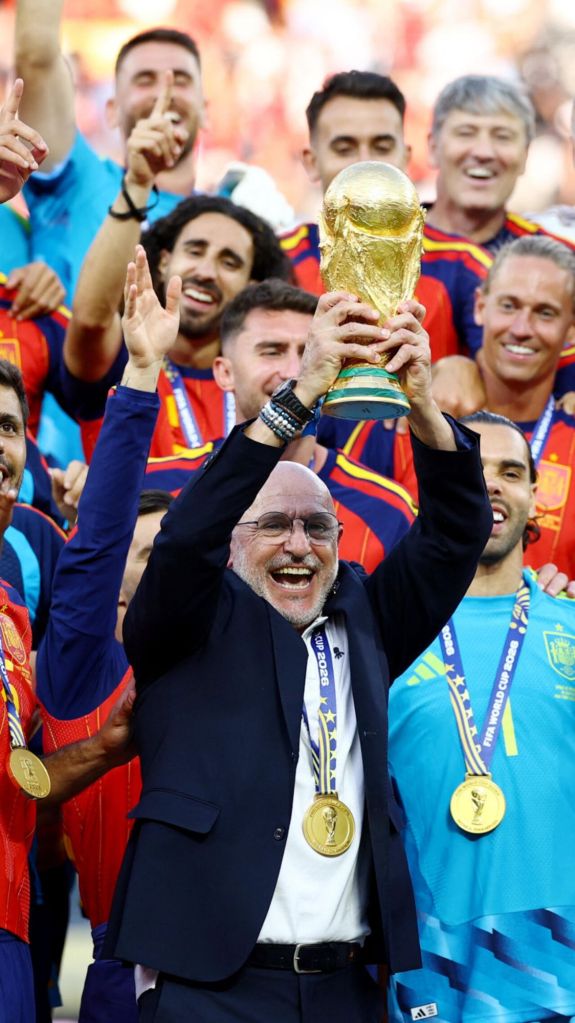
Spain’s 1-0 extra-time victory over Argentina in Sunday’s World Cup final strengthened the argument that the country is currently producing the best football in the world.
The triumph secured Spain’s second World Cup title and added to a remarkable run of success across international football. Spain are also reigning champions of the European Championship and Olympic Games, while the women’s national team holds the Women’s World Cup title.
The latest victory further cements Spain’s dominance across both men’s and women’s football, highlighting the country’s successful development of talent and its distinctive style of play on the global stage.
La Roja secured the World Cup title through their trademark mastery of possession, using relentless ball control to limit opponents’ attacking opportunities. By dominating possession and forcing Argentina to chase the game, Spain restricted Lionel Messi’s influence for large periods of the final.
Across eight matches, Spain conceded just one goal — a Charles De Ketelaere header that beat Pau Cubarsí in the quarter-final against Belgium.


Unlike the physically imposing centre-back pairing of Carles Puyol and Sergio Ramos that helped Spain win the 2010 World Cup, the current defence relied more on composure, intelligence and positioning. Cubarsí and Aymeric Laporte delivered with technical quality and tactical awareness, supported by goalkeeper Unai Simón, whose sharp anticipation and willingness to come off his line repeatedly prevented dangerous attacks.
Simón’s decisive interventions included stopping an early Messi run in the final, similar to his crucial role in denying France’s Kylian Mbappé during the semi-final.
However, Spain’s defenders showed they could match physical challenges when required. Laporte’s sportsmanship was evident when he helped Messi back to his feet after a late challenge in stoppage time — a gesture that contrasted with the more combative style often associated with Spain’s 2010 defensive leaders.
After 19-year-old defender Pau Cubarsí forced Enzo Fernández’s dismissal, leaving Argentina with 10 men during added time and extra time, Spain capitalised on the numerical advantage to find the decisive goal.
Right-back Pedro Porro delivered the crucial cross that set up Ferran Torres’ winner. The move began with Lamine Yamal laying the ball off to Porro, who whipped in a curling cross towards the far post. Nico Williams rose to head the ball down into Torres’ path, allowing the forward to finish with a left-footed half-volley.
While Spain coach Luis de la Fuente’s tactics ultimately delivered another major trophy, the match might have been settled earlier had he started Williams ahead of Álex Baena.
Williams had a 96th-minute goal controversially ruled out and later failed to convert a one-on-one chance against Emiliano Martínez. However, his pace and dribbling caused constant problems for Argentina right-back Nahuel Molina, whom he repeatedly beat before eventually creating the opportunity that led to Torres’ goal.
Cubarsí, meanwhile, continued to attract attention with his maturity beyond his years. Broadcasters affectionately referred to him as “Cubarsito,” highlighting his young age, while the defender’s celebration — flashing a trademark buck-toothed smile as teammates guided him through a ceremonial guard of honour before receiving the Young Player award — underlined the joy of his breakthrough tournament.
Cubarsí also joined an exclusive list of teenage centre-backs to start a World Cup final. The only previous example was Italy’s Giuseppe Bergomi, who was 18 when he featured in the 1982 semi-final and final. Unlike Cubarsí, however, Bergomi appeared older than his age, sporting a moustache and later earning the famous nickname “Lo Zio” (“The Uncle”).
There are few statistics that fully capture the value of Rodri or justify his status as a Ballon d’Or winner. The midfielder finished the World Cup with no goals or assists in eight matches, but his influence extended far beyond the numbers.
Spain’s success highlighted Rodri’s mastery of the midfield role — his ability to read the game, anticipate danger, dictate tempo and control the rhythm of matches. Those qualities, which are difficult to measure statistically, proved crucial to La Roja’s title run.
Returning from knee surgery, Rodri struggled to rediscover the level that earned him the 2024 FIFA Ballon d’Or during his time at Manchester City. However, Pep Guardiola’s prediction that he would regain his best form at the World Cup proved accurate.
Rodri was substituted in the 99th minute for Martín Zubimendi, possibly due to fatigue, although he appeared energetic as he made his way quickly to the bench.


Bigger does not always mean better
FIFA President Gianni Infantino described the tournament as “the greatest … of all time.”
It was certainly the biggest World Cup ever staged, but size alone does not guarantee quality.
FIFA expanded the competition to 48 teams, increasing the tournament to 104 matches played over five weeks. While the larger format introduced more underdog stories and gave additional nations the chance to compete on the biggest stage, memorable surprise teams had also emerged under the previous 32-team format.
The final itself was also extended by several stoppages, including two hydration breaks and a 27-minute halftime show — interruptions that some argued disrupted the flow and intensity of the decisive match.
Lionel Messi endured another painful title-game experience at East Rutherford, the same venue where Argentina suffered a heartbreaking defeat in the 2016 Copa América Centenario final.
Argentina lost to Chile on penalties after a 0-0 draw, with Messi missing his spot-kick as the South American giants fell short once again. Following that defeat, Messi was quoted as saying he would retire from international football, although his remarks were later understood differently — he was seeking a break from the disappointment of repeated losses rather than an end to his national team career.
The defeat continued a difficult period for Argentina in major finals. They had also lost to Chile on penalties after another goalless draw in the 2015 Copa América final, before falling 1-0 to Germany in extra time of the 2014 World Cup final.
On Sunday, however, Messi’s frustration came from a different source. His Argentina teammates struggled to get him on the ball frequently enough, limiting his influence during the match and preventing him from dictating the game as he often has throughout his career.
The result also reinforced the immense difficulty of winning consecutive World Cup titles — a feat that remains one of the toughest achievements in international team sports.
-Aljazeera
Invest or Donate towards HICGI New Agency Global Media Establishment – Watch video here
Email: editorial@hicginewsagency.com TalkBusiness@hicginewsagency.com WhatsApp +256713137566
Follow us on all social media, type “HICGI News Agency” .

