
Updated by Faith Barbara N Ruhinda at 1504 EAT on Monday 31 August 2026
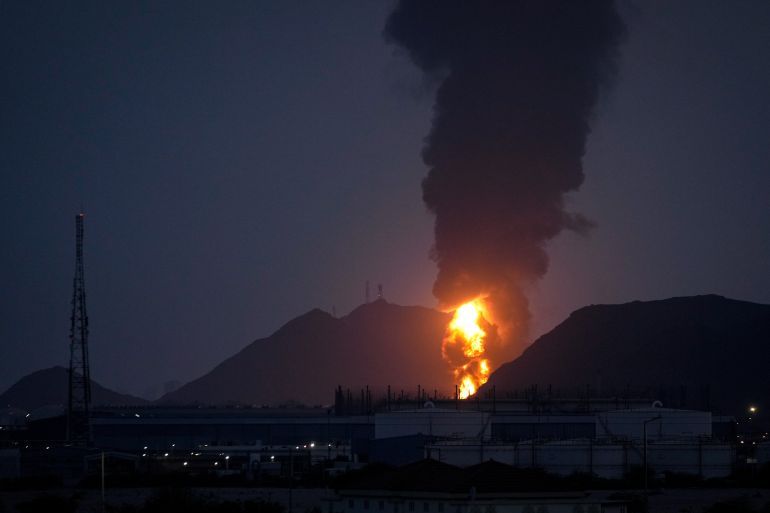
The United Arab Emirates (UAE) says it intercepted a drone approaching from Iran over its territorial waters, while denying reports that its Al Menhad airbase had come under attack, following the resumption of hostilities between the United States and Iran for the first time since July.
Iran’s army said in a statement cited by Iranian news agencies that dozens of drones had been launched early Monday targeting US military assets at the Al Menhad airbase in the UAE.
In a statement posted on X on Monday, the UAE Ministry of Defence described the reports as “false” and urged the public to rely on official sources for information, warning against circulating rumours or inaccurate information.
Later, the ministry said the UAE Air Force had intercepted a drone “over the country’s territorial waters, approaching from Iran”.


The incident followed an overnight exchange of attacks between the United States and Iran, further dimming hopes for an end to the more than six-month-long conflict.
US forces on Sunday struck two Iranian launchers on Larak Island, about 660km (410 miles) east of Kharg Island, according to a US official. Iran retaliated by attacking two bases used by US forces in Jordan and the UAE’s Al Menhad airbase, Iranian media reported.
Iran’s Ministry of Foreign Affairs said the strikes in Jordan targeted US bases used to launch and support the attack on Larak.
The Iranian army said its drone attack on the UAE airbase targeted locations where US forces and helicopters were stationed, in response to casualties from the Larak strikes.
Iran has carried out a series of attacks on Gulf countries since the US and Israel launched their war against Iran in late February. However, following calls from Gulf allies Qatar, Saudi Arabia and the UAE, US President Donald Trump said on August 1 that he would order the military to hold off on further strikes against Iran.
The UAE’s presidential adviser, Anwar Mohammed Gargash, condemned the renewed escalation, saying that “the policy of targeting the Arab Gulf states and Jordan has proven to be a failure.”
“Political solutions must begin with de-escalation and restoring normal shipping through the Strait of Hormuz,” Gargash added.
Stalled negotiations
Sunday’s return to hostilities comes as the Trump administration has intensified economic pressure on Iran and its business partners through new sanctions, while mediators have stepped up efforts to revive negotiations aimed at ending the war.
High-level delegations from mediating countries, including Oman, Pakistan and Qatar, visited Tehran last week in an effort to advance negotiations and find a path towards ending the conflict.


The Strait of Hormuz remains a major sticking point in the negotiations. Last week, US President Donald Trump said all mines had either been detonated or removed from international waters in the strait, warning Iran that any vessel attempting to lay new mines would be destroyed.
However, while Trump has repeatedly maintained that the Strait of Hormuz is open, Iran’s Islamic Revolutionary Guard Corps (IRGC) has dismissed the claims as “an obvious lie”, insisting that the waterway remains closed to vessels without Iranian permission to transit.
Before the war, the strategic waterway carried nearly one-fifth of the world’s crude oil and liquefied natural gas shipments, making its continued disruption a major concern for global energy markets.
-Aljazeera
Invest or Donate towards HICGI New Agency Global Media Establishment – Watch video here
Email: editorial@hicginewsagency.com TalkBusiness@hicginewsagency.com WhatsApp +256713137566
Follow us on all social media, type “HICGI News Agency” .

