
Updated by Faith Barbara N Ruhinda at 1707 EAT on Tuesday 1 September 2026
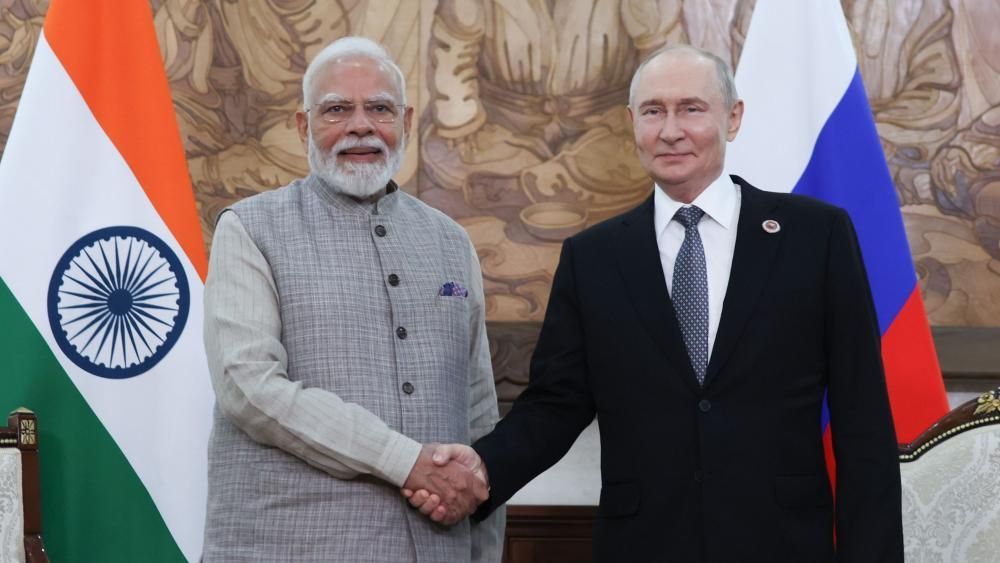
“Every day spent in war pushes humanity back, and every step taken towards peace fills humanity with new hope and enthusiasm,” Modi said on Monday.
Modi, whose country’s economy relies heavily on discounted oil imports from Moscow, has made several similar appeals to Putin since Russia launched its full-scale invasion of Ukraine in 2022.
BBC correspondents in Delhi and Moscow examine the reasons behind Modi’s renewed call for peace and assess Putin’s response.
Vikas Pandey, India editor, Delhi
Modi’s latest comments calling for an end to the war in Ukraine are not surprising and do not signal any major shift in India’s foreign policy.
In fact, while attending a regional summit in 2022, less than a year after the war began, Modi publicly told Putin that “now is not the time for war”.
However, it would be an oversimplification to interpret Modi’s current or previous statements on the war as a rebuke of Putin or a rejection of Russia’s strategy.
Western countries have repeatedly pressed Modi to take a clearer position on the war, but New Delhi has largely maintained a neutral stance, consistently calling for dialogue and diplomacy to bring the conflict to an end.
The position has frustrated many Western capitals, but they have continued to court Modi and strengthen ties with India, whose large and rapidly growing economy makes it too important to ignore.

Against this backdrop, Modi’s latest statement should not be viewed as an attempt to appease a third country.
If anything, Modi’s remarks are consistent with India’s long-standing policy of strategic autonomy. This, however, raises the question: why would Modi make such a statement about the war so publicly?
The answer lies in the longstanding ties between India and Russia. The two countries have generally found ways to cooperate despite viewing global geopolitics through different lenses.
Moscow has remained one of India’s closest allies, even as New Delhi has strengthened its relationships with Europe and the United States over the past three decades.
India is a founding member of the Brics grouping alongside Russia and China, and is also a member of the Shanghai Cooperation Organisation, which includes both countries.
At the same time, New Delhi is part of the Quad, a strategic grouping with Australia, Japan and the United States – an association that has drawn criticism from Moscow.
Still, Moscow and New Delhi have generally managed to work through their differences. Russia remains a major supplier of India’s defence equipment, accounting for around 40% of its defence imports, and has also been a key supplier of the country’s energy needs.
Modi’s latest statement is therefore not expected to cause a rift in Moscow-New Delhi relations. Analysts say it is also unlikely to have come as a surprise to Putin or Russian diplomats.
For Western governments and Modi’s critics in India, however, the comments may not go far enough. They are likely to argue that the prime minister should have been more direct in condemning the war.


Steve Rosenberg, Russia editor, Moscow
This is not the first time a foreign leader has publicly urged Putin to end the war in Ukraine.
Just five weeks ago, Kazakhstan’s President Kassym-Jomart Tokayev called on Putin to freeze the conflict and return to the negotiating table.
-BBC
Invest or Donate towards HICGI New Agency Global Media Establishment – Watch video here
Email: editorial@hicginewsagency.com TalkBusiness@hicginewsagency.com WhatsApp +256713137566
Follow us on all social media, type “HICGI News Agency” .
 HICGI News Agency