
Updated by Faith Barbara N Ruhinda at 1515 EAT on Monday 12 October 2026
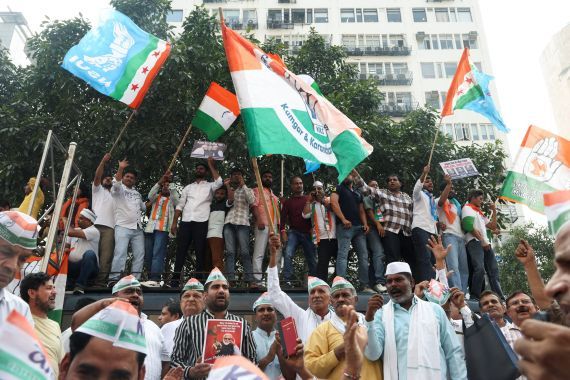
India’s opposition parties are marching to the Supreme Court in New Delhi to demand the resignation of the country’s election chief over allegations of voter fraud.
The march is the latest in a series of demonstrations in the capital, where thousands of security personnel have been deployed and roads barricaded.
Attempts by the Cockroach Janata Party pressure group to stage a protest over the weekend resulted in thousands of demonstrators being detained.
Opposition parties allege that voter rolls have been manipulated under Chief Election Commissioner Gyanesh Kumar to benefit Prime Minister Narendra Modi’s Bharatiya Janata Party (BJP). Both the Election Commission and the BJP have rejected the allegations.
The opposition lawmakers intend to submit a memorandum to Chief Justice Surya Kant. However, Kant told reporters that he had declined their request for a meeting, citing “certain reasons”.
Kant did not disclose the reasons for declining the meeting. However, media reports citing his letter said he had noted that some of the issues the opposition wanted to raise were already pending before the court. The BBC said it had not seen the letter.


“Every Indian citizen has the right to approach the court, and we will hear their concerns and grant whatever is due under the law,” Kant told reporters.
Meanwhile, Congress MP Rahul Gandhi called on “all opposition parties, civil society groups [and] all those who believe in democracy” to join Monday’s march.
At a press conference on Monday, Gandhi presented a letter he and Congress President Mallikarjun Kharge had written to the Chief Justice, outlining their concerns over Kumar’s alleged conduct and the controversial revision of electoral rolls.
Gandhi said Kant had advised them to file a petition, which they planned to submit after the march.
Authorities in Delhi announced major traffic restrictions and limits on entry and exit at some key metro stations. Security was also heightened in central Delhi and along the march route.
Thousands of people gathered on Barakhamba Road, where the march began, as a bus carrying Gandhi and other opposition leaders arrived shortly before 3:30pm local time. Supporters waved flags and chanted Gandhi’s name as the Congress MP and other leaders waved to the crowd through the windows.
Seated a few rows behind Gandhi was Neha Bora, a left-wing student leader who has gained prominence through her participation in protests.
Over the past week, several senior opposition leaders, including Gandhi, have been briefly detained while leading demonstrations in central Delhi.
On Sunday, the Cockroach Janata Party (CJP), which is not a registered political party, said it would continue its protests until Kumar resigned.
The CJP, which led a successful protest over the summer that culminated in the resignation of India’s federal education minister, had called for a march on Saturday to Jantar Mantar, Delhi’s best-known protest site, which also hosted the previous round of sit-in demonstrations.


However, authorities imposed sweeping restrictions that made it difficult for protesters to reach the site. Train services were cancelled, dozens of metro stations were closed, and tens of thousands of police and paramilitary personnel were deployed on the streets to detain demonstrators.
CJP leaders, including founder Abhijeet Dipke and co-convenors Saurav Das and Ashutosh Ranka, were detained from an aircraft shortly after it landed in Delhi, where they had travelled to join the protest.
They were released the following day. Dipke returned home to attend his grandmother’s funeral, while Das and Ranka held a press conference and vowed to continue the protests. Neither leader joined Sunday’s demonstrations, but both said they would seek a new protest date from the police.
Over the weekend, police detained and later released thousands of people, including several journalists. Videos and photographs from the protests showed officers forcibly dragging demonstrators, including women, and pushing them into buses.
The BBC also captured footage of a police officer slapping a detained protester inside a bus. The Delhi Police did not respond to questions about the alleged use of violence against demonstrators.
In a statement, Reporters Without Borders condemned the detention of at least 16 Indian journalists.
“Covering events of public interest is not a crime. It is their job. The police’s actions against the press are unacceptable,” the organisation said.
-BBC
Invest or Donate towards HICGI New Agency Global Media Establishment – Watch video here
Email: editorial@hicginewsagency.com TalkBusiness@hicginewsagency.com WhatsApp +256713137566
Follow us on all social media, type “HICGI News Agency” .

