
Updated by Faith Barbara N Ruhinda at 1313 EAT on Tursday 20 October 2026
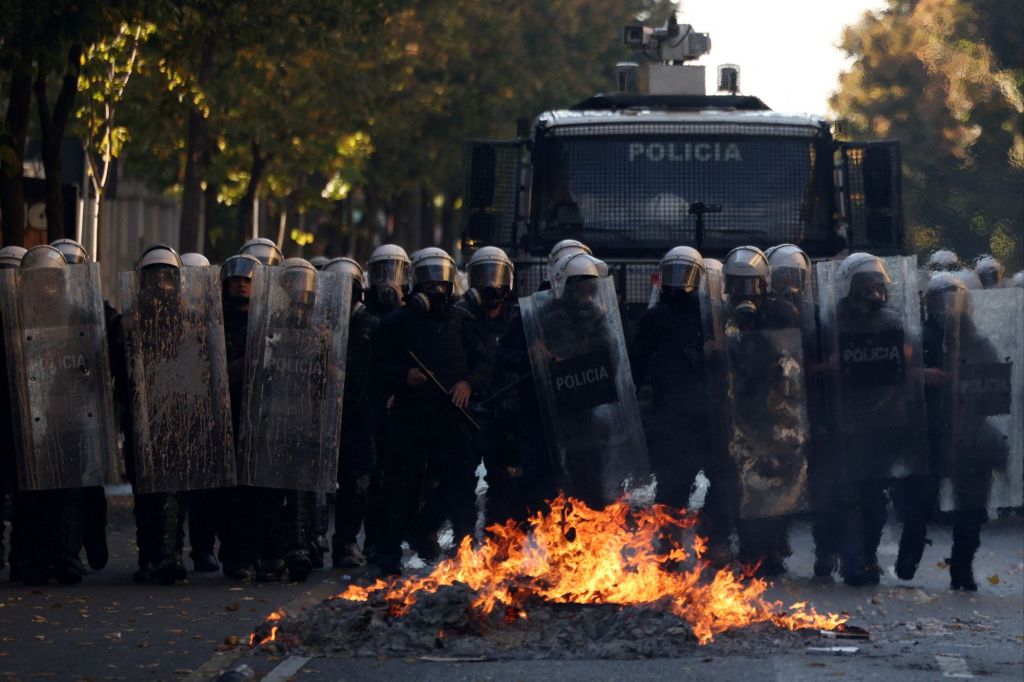
Protesters in Albania clashed with riot police for the seventh consecutive day on Monday, as demonstrations against Prime Minister Edi Rama intensified.
The protesters, many of them high school and university students, are demanding Rama’s resignation. Official figures showed that 295 people had been injured before Monday’s violence, including 186 police officers.
“The moment the state negotiates with this, the state has fallen,” Rama told stern-faced police chiefs, holding up a rock allegedly thrown at police officers on Sunday.
A police station and government buildings in Tirana have been attacked during the demonstrations, which have been fuelled by demands for better university conditions, anger over corruption and calls for Rama to step down.
Rama accused the protesters of being “young men and women who have been radicalised by dark forces in Europe and the US”, adding that “Albania has become one of the targets of a well co-ordinated attack”.
Under bright October sunshine in Rinia Park, also known as Youth Park, protesters were seen prising loose cobblestones to use as projectiles against police, similar to the rock displayed by the prime minister.
The confrontation soon resumed, with protesters and police facing off once again.


A convoy of police vehicles advanced along a broad boulevard, led by an armoured truck firing water cannon and tear gas canisters into the crowd of fleeing protesters.
Squads of riot police chased the predominantly student protesters through the park. Some sought refuge in a café, where even the waiters’ eyes streamed from the tear gas.
Under the trees, volunteers wearing yellow reflective jackets stood their ground, helping people overcome by the fumes. I watched as a young man confronted a police officer, who then sprayed pepper spray directly into his face at point-blank range.
“Police actions are often chaotic and stupid,” human rights lawyer Gentian Sejrani told the BBC. He is providing legal support to more than 100 people arrested during the protests.
“In court, the police rarely present evidence,” he said. Among his clients is a man who was arrested while walking to a bus stop, despite having no connection to the demonstrations, according to Sejrani.
“Those who are actually throwing stuff at the police rarely get caught, because they run the fastest,” he said.
Police officers appear as angered by attacks on their colleagues as protesters are by what they describe as heavy-handed policing. The result is widespread disorder.
Outside the café in the park, after the tear gas had cleared, 27-year-old activist Sidorela Vatnikaj, a master’s student, described what a typical day looks like for her. In a leaderless movement, she is among the more experienced activists, having spent eight years at the forefront of anti-government protests.
“In the morning, you try to co-ordinate with all the groups — where they are and where the protest is taking place. You check whether lawyers, first-aid kits or any other equipment are needed. You also have to make sure your friends and family members at the protest are OK,” she said.


She spends much of the day moving between demonstrations, often running from police, she added.
Vatnikaj said she was uncomfortable with protesters’ violence against the authorities but blamed the police for provoking and escalating the clashes.
“When I see people throwing stones at the police, I understand their anger. I don’t judge them. I’m not happy, but they have no other way to be listened to,” she said.
“They come from families whose members had no choice but to leave the country — a million in the past decade. They have not only been robbed, they have been bullied, ignored and now they have also been beaten up.”
At the weekend, Rama asked rhetorically what would happen if he stepped down.
“We need a technocratic government for one year, to prepare the country for real, democratic elections,” Vatnikaj said in response.
She accused Rama of rigging previous elections and being closely aligned with wealthy foreign investors and organised crime groups. These remain her allegations.
Vatnikaj said young people in Albania drew encouragement from fellow Generation Z protesters around the world.
“I have seen my mother and father’s generation working all their lives and dreaming of having a democratic society where they could live with dignity. That never happened,” she said.
-BBC
Invest or Donate towards HICGI New Agency Global Media Establishment – Watch video here
Email: editorial@hicginewsagency.com TalkBusiness@hicginewsagency.com WhatsApp +256713137566
Follow us on all social media, type “HICGI News Agency” .

