
Updated by Faith Barbara N Ruhinda at 1220 EAT on Wednesday 28 October 2026
Fleur Hassan-Nahoum, a former deputy mayor of Jerusalem and trade envoy, previously supported Benjamin Netanyahu but joined a breakaway right-wing party, Amcha Yisrael (People of Israel), ahead of the election.
Speaking to BBC Radio 4’s Today programme, Hassan-Nahoum described the continued support for Netanyahu as “incredible” after what she called “the disaster of October 7th”.
She said Amcha Yisrael had sought to offer an alternative on the right of Israeli politics, but acknowledged that the party was unlikely to win enough votes to enter the Knesset, Israel’s parliament.
“There is still enormous support for Netanyahu. I’m not sure if it’s love or fear, or maybe a combination of both, of what happens without him, but that’s where we’re at,” she said.
On October 7, 2023, Hamas attacked southern Israel, killing about 1,200 people and taking 251 others hostage, according to Israeli figures. Israel’s subsequent military campaign in Gaza has killed more than 74,500 Palestinians, according to the territory’s health ministry.
No party has ever won an outright majority in Israel’s parliament, the Knesset, making coalition governments a regular feature of the country’s political system.
Once the votes have been counted, Israel’s president consults party leaders before inviting the candidate deemed most likely to form a government to do so.
The designated candidate has 28 days to assemble a governing coalition, with the option of requesting a 14-day extension if more time is needed.
If the candidate fails to reach an agreement within the stipulated period, the president can appoint another candidate to attempt to form a government.
Should that effort also fail, Knesset members can ask the president to give a third candidate the opportunity. If all attempts are unsuccessful, fresh elections are called.
Between 2019 and 2022, Israel held five elections as political parties repeatedly struggled to reach agreements on forming stable governments.
In the 2022 election, Benjamin Netanyahu’s Likud party emerged as the largest, winning 32 of the Knesset’s 120 seats. He subsequently formed a coalition with several far-right parties, securing a parliamentary majority of 64 seats for his government and its allies.
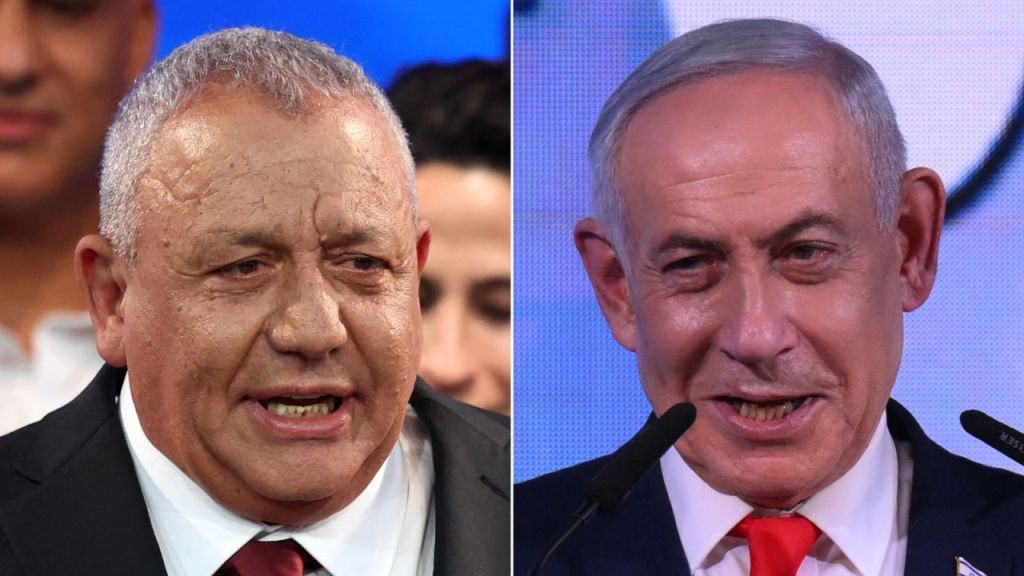
Both Benjamin Netanyahu and Gadi Eisenkot addressed their supporters overnight, each expressing confidence in forming Israel’s next government.
“The right-wing bloc has a clear, decisive majority among the Zionist public, among the Jewish public and all those who support the Jewish state. That is what has become clear. A decisive majority,” Netanyahu told cheering supporters, although he stopped short of declaring victory.


“We must form a strong, national, right-wing government. That is what must be done,” he added.
Eisenkot, addressing supporters of his Yashar party after exit polls were released, said voters had chosen change. Most of the initial exit polls had favoured the opposition.
“The public has chosen change,” he said. “The coalition of failure has lost the people’s trust. The Israeli public voted against Benjamin Netanyahu continuing as prime minister.”
Eisenkot pledged to work with his allies to form a government that would reflect the electorate’s decision.
“I will work with my partners to ensure that the people’s decision is translated into a Zionist government: stable and good for all of Israel’s citizens. And quickly — because that is what this moment demands, and because the country needs to be brought back together,” he said.
With results still coming in, Israeli Prime Minister Benjamin Netanyahu appears to have performed better than widely predicted, with his Likud party emerging as the largest single party.
His existing bloc of ultra-nationalist and ultra-Orthodox Jewish parties appears to be just short of the 61 seats needed for a majority in the 120-member Knesset. However, analysts have cautioned that the picture could change as counting progresses, with early results favouring areas known for strong right-wing support.
A political deadlock had been widely predicted as Israelis turned out to vote, with turnout exceeding 77 per cent.
Under Israel’s fragmented political system, Netanyahu’s main rival, former army chief Gadi Eisenkot, appears likely to struggle to secure a parliamentary majority without the support of parties representing Israel’s Arab minority. Partial results suggest these parties have matched or surpassed their previous record number of seats.
During the campaign, most Jewish opposition parties pledged not to cooperate with Arab-majority parties, citing a lack of shared values.
However, Arab-led parties could emerge as kingmakers if other political groups are willing to work with them. Arab Israelis, who often identify as Palestinian citizens of Israel and make up about one-fifth of the population, appear to have turned out in unprecedented numbers in the election.
Many viewed the vote as a decisive opportunity to oust what they consider Israel’s most right-wing government, accusing it of promoting racism and hatred.
The latest figures from Israel’s Central Elections Committee show a close race between the blocs led by Prime Minister Benjamin Netanyahu and his main rival, Gadi Eisenkot, with more than half of the votes counted.
Israeli broadcasters Kan News, Channel 12 and Channel 13 have updated their projections, putting Netanyahu’s bloc at 55 seats and Eisenkot’s at 49.
A bloc needs at least 61 of the Knesset’s 120 seats to secure a parliamentary majority and form a government.
The figures remain provisional and could change as vote counting continues.
Voter turnout on Tuesday reached its highest level in decades, standing at 77.7 per cent when polling stations closed at 22:00 local time (20:00 GMT), according to the Central Elections Committee. The turnout was the highest recorded at that hour since 1999.
Welcome back as we resume live coverage of Israel’s election results, with about half of the votes counted.


The outcome remains uncertain, with neither of the two main political blocs currently projected to secure a majority in the Knesset, Israel’s parliament.
Projections put the bloc led by veteran Prime Minister Benjamin Netanyahu ahead with 55 seats, while that of his main rival, former military chief Gadi Eisenkot, is projected to win 49 to 50 seats.
Arab-led parties are meanwhile projected to secure about 15 to 16 seats.
The seat distribution continues to shift as counting progresses, with all votes not expected to be counted until later on Thursday.
Tuesday’s election was the first since the Hamas-led attacks on Israel on October 7, 2023, and the wars that followed in Gaza, Lebanon and Iran.
Many Israelis viewed the vote as one of the most consequential in the country’s history, as it could determine not only the country’s leadership but also whether Israel continues along its current hard-line, religious-nationalist path.
Key campaign issues included accountability for the security failures surrounding the October 7 attacks, the conduct of regional wars, the growing burden of military service, judicial reforms and Israel’s international standing.
Before concluding his speech, Netanyahu told supporters that Israel had a “unique opportunity” to work with US President Donald Trump to “remove the Iranian threat once and for all”.
Israel and the United States launched joint strikes on Iran in 2025, targeting nuclear facilities, before launching further attacks in February that triggered the current conflict.
Commentators say a government led by either Netanyahu or Eisenkot is unlikely to change Israel’s current course in the war against Iran.
Netanyahu has said it is too early to determine the election outcome, insisting he is waiting for “real results” before drawing conclusions.
Current projections show his bloc level with that of his main rival, Gadi Eisenkot.
Netanyahu said Israel could not be governed by a coalition reliant on “Arab backing”.
Arab-led parties are projected to win a record number of seats, while both major blocs remain short of the 61 seats needed to secure a majority in the Knesset, Israel’s parliament.
Benjamin Netanyahu is addressing supporters at an election rally attended by members of his Likud party.
“Likud is the largest party,” he told the cheering crowd.
“We must establish a strong right-wing national government,” he added.
Although current projections show Likud winning more seats than any other party, it remains short of the numbers needed to secure a parliamentary majority on its own.
Revised exit polls from two Israeli broadcasters show Netanyahu’s bloc tied with that of the opposition, while a third broadcaster puts his bloc marginally ahead.
With vote counting still underway, Israel’s election remains too close to call. Although Benjamin Netanyahu’s Likud party appears to have emerged as the largest single party, neither his bloc nor the opposition has secured the 61 seats needed for a parliamentary majority.
The final outcome will depend on the remaining votes and whether either side can secure enough support from other parties to form a governing coalition.
-BBC
Invest or Donate towards HICGI New Agency Global Media Establishment – Watch video here
Email: editorial@hicginewsagency.com TalkBusiness@hicginewsagency.com WhatsApp +256713137566
Follow us on all social media, type “HICGI News Agency” .

