
Updated by Faith Barbara N Ruhinda at 0855 EAT on Monday 2 November 2026
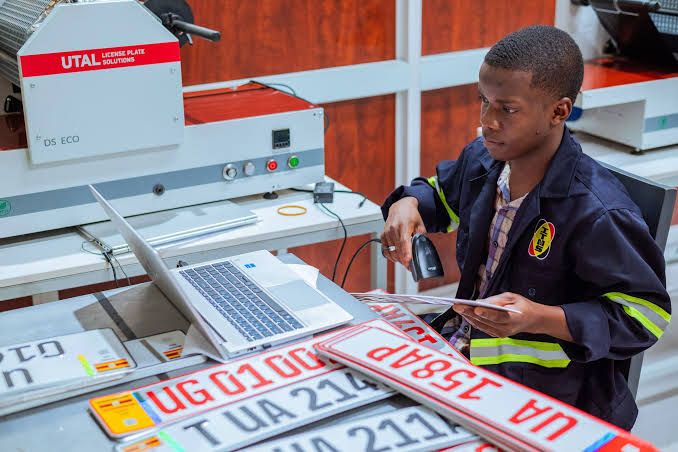
President Yoweri Museveni has cautioned Members of Parliament investigating Uganda’s controversial digital number plate project against producing inaccurate reports, saying the system was primarily introduced to strengthen national security.
The warning, disclosed by the Permanent Secretary in the Office of the President, Yunus Kakande, follows a meeting at State House last Thursday, during which legislators raised concerns about the project’s rising costs, technical capabilities and contractual arrangements with Russian firm Joint Stock Company Global Security (JSCGS).
The meeting came amid revelations that the project’s estimated contract value had increased, raising questions about the additional financial obligations and whether the system could deliver its intended security benefits.
Speaking to the media, Kakande said Museveni acknowledged Parliament’s oversight role but urged legislators to engage the technical teams implementing the project before drawing conclusions.
“But the President advised them that if the project is for security, they should not just come up with reports which are not correct,” Kakande said.
“Did they sit with us and we agree and talk and negotiate and agree with them? So there was no such thing as saying that the system is not working. And the MPs also accepted this,” he added.
The parliamentary investigation, led by the Physical Infrastructure Committee chaired by Mbarara City South MP Mwine Mpaka, has examined concerns about the performance and effectiveness of the vehicle-tracking technology.



During parliamentary proceedings, former Works and Transport Minister Gen Katumba Wamala defended the project as an essential security intervention, while former Internal Affairs Minister Gen Kahinda Otafiire questioned its effectiveness.
Kakande, however, dismissed suggestions that Museveni had been misled into approving the Russian-backed technology.
Kakande denied that Museveni had made the statement attributed to him, saying the President instead explained to legislators how the Russian contractor had introduced the technology as a security solution.
“The President never said such a statement. It was not there. Actually, he elaborated to various members of Parliament that this gentleman is from Russia. He came and approached him,” Kakande said.
“He showed him the technology which he has; the software which he has, which can be used to apprehend criminals. And that’s how he started. Originally, it was a security programme, for cars: to get criminals,” he added.
The digital number plates project followed Museveni’s 2018 directive to strengthen vehicle identification and tracking after a series of high-profile assassinations, including the killing of Arua Municipality MP Ibrahim Abiriga.
The government subsequently signed an agreement with Russian firm Joint Stock Company Global Security (JSCGS) in 2021 to implement the Intelligent Transport Monitoring System (ITMS).
Motorists currently pay Shs714,300 for a digital number plate kit for newly registered vehicles and motorcycles. Replacing conventional number plates costs Shs150,000 for vehicles and Shs50,000 for motorcycles.
Kakande maintained that the technology was already operational, although some components still required improvement.
“We resolved with this machine; the system is working so well. It can retrieve any vehicle anywhere in the country,” he said.
“The primary objective was security. And the system is working well.”
He acknowledged, however, that the government was reviewing the project’s financial model, particularly the proposed revenue-sharing arrangement between the Russian contractor and the Ugandan government.
“We are already now trying to refine the financial model to say, if we start issuing the final issuance system, how is it going to work, and how much will the provider and the Uganda government get, and then we move,” he explained.
Kakande further disclosed that Museveni had directed the formation of three teams involving representatives of the Russian company, government technical officials and parliamentarians to address outstanding concerns.

“No, the resolution was not there because we agreed that His Excellency, the President, that we should make three teams; that is the Russian company managers will come with the technical people in government and the parliamentarians, and we talk and agree on some of the issues which we need to be streamlined,” he said.
He added that some software components would need upgrading to improve the system’s performance.
“What we need is to upgrade certain software here and there.”
Kakande confirmed that another meeting involving the Russian contractors, government officials and MPs had been scheduled.
“Yes, he has called for a meeting very soon. We shall meet with the Russians, with the officers who are implementing it and the members of parliament who are taking the role of oversight,” he said.
The developments come as Parliament prepares its findings on the digital number plates project.
-Observer
Invest or Donate towards HICGI New Agency Global Media Establishment – Watch video here
Email: editorial@hicginewsagency.com TalkBusiness@hicginewsagency.com WhatsApp +256713137566
Follow us on all social media, type “HICGI News Agency” .

