
Updated by Faith Barbara N Ruhinda at 1039 EAT on Wednesday 22 April 2026
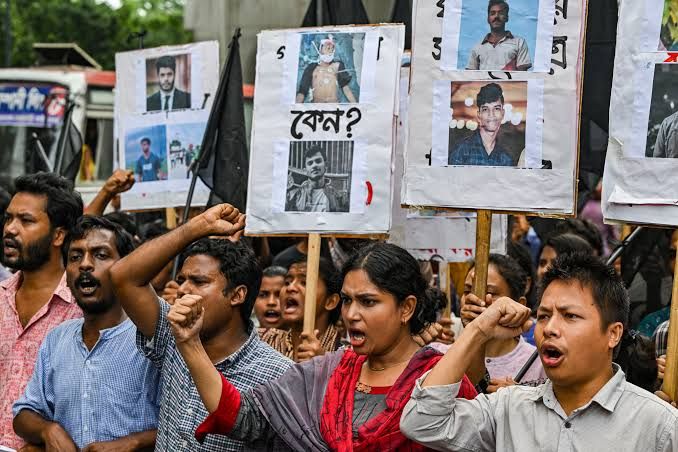
Bangladesh’s parliament has rolled back several reforms introduced in the wake of the 2024 student-led uprising, measures that had been aimed at strengthening accountability within government and the security forces. The move has raised concerns that the country may be retreating from democratic gains made since the ouster of former prime minister Sheikh Hasina.
Dominated by the ruling Bangladesh Nationalist Party, which swept to power in February’s elections, lawmakers have in recent days reviewed a package of 133 ordinances. Several of these were tied to reform initiatives introduced by the interim administration led by Nobel laureate Muhammad Yunus, which governed the country after Hasina fled to India.
Of the measures reviewed, at least 23 — including pivotal provisions on human rights, judicial oversight, anti-corruption and policing — have either been repealed or allowed to expire after failing to gain parliamentary approval within the required constitutional window.
Although the bulk of the ordinances has been ratified, those that have lapsed are widely regarded as critical to overhauling institutions long accused of political interference, opacity and weak accountability.

Opposition parties, civil society organisations and a number of analysts have criticised the move as a dilution of key safeguards agreed in the wake of the uprising, cautioning that it risks undermining oversight and concentrating power within the executive.
Government officials, however, defend the process as a routine legislative audit, arguing that flawed provisions are being removed to pave the way for stronger, more comprehensive laws following stakeholder consultations.
The current dispute stems from the July 2024 uprising — a student-led movement that forced the ouster of former prime minister Sheikh Hasina amid mounting criticism of authoritarian governance, suppression of dissent, alleged enforced disappearances and wider human rights violations.
Her removal ushered in a rare period of political alignment, with major parties — including long-time rivals — converging on the need for sweeping structural reforms.
An interim administration led by Nobel laureate Muhammad Yunus assumed office and spearheaded the July National Charter, a broad reform framework covering judicial independence, human rights, electoral integrity and decentralisation. Backed by more than two dozen political parties, the charter was later endorsed in a nationwide referendum held alongside the February 2026 general election, securing about 70% support.
Rather than incremental policy change, the charter set out an ambitious vision to recalibrate the balance of power across state institutions.
However, with parliament dissolved in the aftermath of Hasina’s departure, the interim government lacked the mandate to enact the reforms into law. It instead issued a series of ordinances across key sectors, many reflecting the charter’s priorities.

Under constitutional provisions, such ordinances must be presented to parliament within 30 days of its first sitting and either approved, amended or allowed to expire.
When the new parliament convened in March 2026, lawmakers were tasked with reviewing all 133 ordinances introduced during the interim period. Official figures show that 110 were approved — some with revisions — while 23 fell away, including seven that were formally repealed and 16 that lapsed after not being put to a vote.
The measures that did not survive include those governing the National Human Rights Commission, enforced disappearances, judicial appointments, the administration of the Supreme Court, police reform and anti-corruption oversight — all widely regarded as pillars of the post-uprising reform agenda.
One of the most consequential reversals concerns the National Human Rights Commission (NHRC), the state body mandated to investigate rights violations.
Under a 2025 ordinance, the NHRC had been granted expanded powers aimed at strengthening its independence and effectiveness. These included authority to investigate allegations against state agencies — including the police and security forces — defined timelines for inquiries, clearer provisions on compensation and accountability, and greater administrative and financial autonomy.
That ordinance has now been repealed, with the earlier 2009 law reinstated. Critics say the older framework contains significant limitations, notably restricting the commission’s ability to independently investigate security forces. Under the 2025 provisions, the NHRC could directly probe allegations of abuse; under the 2009 law, it is limited to requesting a government report and issuing recommendations.
Observers warn that this arrangement creates a potential conflict of interest and raises fresh concerns about the commission’s independence.

The government, however, argues that the ordinance contained legal ambiguities and required further scrutiny — particularly regarding investigative powers, penalties and procedural clarity — and says it intends to introduce a revised version following broader consultations.
In an open letter, five outgoing commissioners have challenged that position, saying the government’s objections do not accurately reflect the ordinance’s provisions.
Former commissioner Nabila Idris said the issues cited by authorities had already been addressed. “The government is bringing up spurious complaints about the ordinances,” she told Al Jazeera.
She cautioned that weakening legal safeguards could have far-reaching implications. “Two things are needed — legal protection and political will,” she said. “Right now, there appears to be a belief that political will alone is sufficient, even if legal protections are weak. But that is not how accountability works.”
A government-formed Commission of Inquiry on Enforced Disappearances, established under the interim administration of Muhammad Yunus, received more than 1,900 complaints and verified at least 1,569 cases. These include hundreds classified as “missing and presumed dead”, with investigators warning that the actual figure could be significantly higher.

For years, families of victims have pushed for formal recognition of enforced disappearance as a criminal offence, along with stronger legal mechanisms for accountability and prosecution.
The repealed ordinance had sought to meet those demands by explicitly defining enforced disappearance as a distinct crime, setting out procedures for investigation and prosecution, and providing families with a clearer legal route to justice.
Its removal has prompted concerns among legal experts about a growing accountability gap. “If a crime is not clearly defined, it becomes difficult to punish,” said Nabila Idris, a former commissioner of the National Human Rights Commission. She noted that existing laws do not recognise enforced disappearance as a standalone offence.
“When safeguards are weakened, it creates space for abuse,” she said. “Leaving that space open is like leaving a door unlocked — eventually, someone will walk through it.”
Under current arrangements, Bangladesh’s International Crimes Tribunal (ICT) — originally set up to try war crimes — can only prosecute enforced disappearances when they form part of a widespread or systematic pattern, and does not handle individual cases. Ordinary criminal law also does not clearly define the offence.
Legal analysts say this creates a jurisdictional gap in which many cases may fall outside both systems, complicating prosecution and limiting recourse for victims’ families. Idris, who also served on the commission, warned that the absence of a clear legal definition weakens deterrence. “If a crime is not clearly defined in law, accountability becomes much harder,” she said.
The rollback of key post-uprising reforms has deepened concerns among opposition figures, rights groups and legal experts that the momentum for institutional change is fading just months after one of the most significant political transitions in Bangladesh’s recent history.
Supporters of the reforms argue that the ordinances represented a rare attempt to rebuild trust in institutions long accused of politicisation and weak accountability. Their removal, they say, risks narrowing the scope of oversight at a time when demands for transparency remain high.
The government maintains that the review process is still ongoing and insists that revised legislation will be introduced after further consultation. It has framed the changes as part of a broader effort to refine — rather than abandon — the reform agenda.
But for victims’ families and rights advocates, the concern is more immediate: that delays, reversals and legal uncertainty could further entrench impunity, leaving unresolved some of the most sensitive legacies of Bangladesh’s turbulent political transition.
-Aljazeera
Invest or Donate towards HICGI New Agency Global Media Establishment – Watch video here
Email: editorial@hicginewsagency.com TalkBusiness@hicginewsagency.com WhatsApp +256713137566
Follow us on all social media, type “HICGI News Agency” .

