
Updated by Faith Barbara N Ruhinda at 1153 EAT on Wednesday 10 June 2026
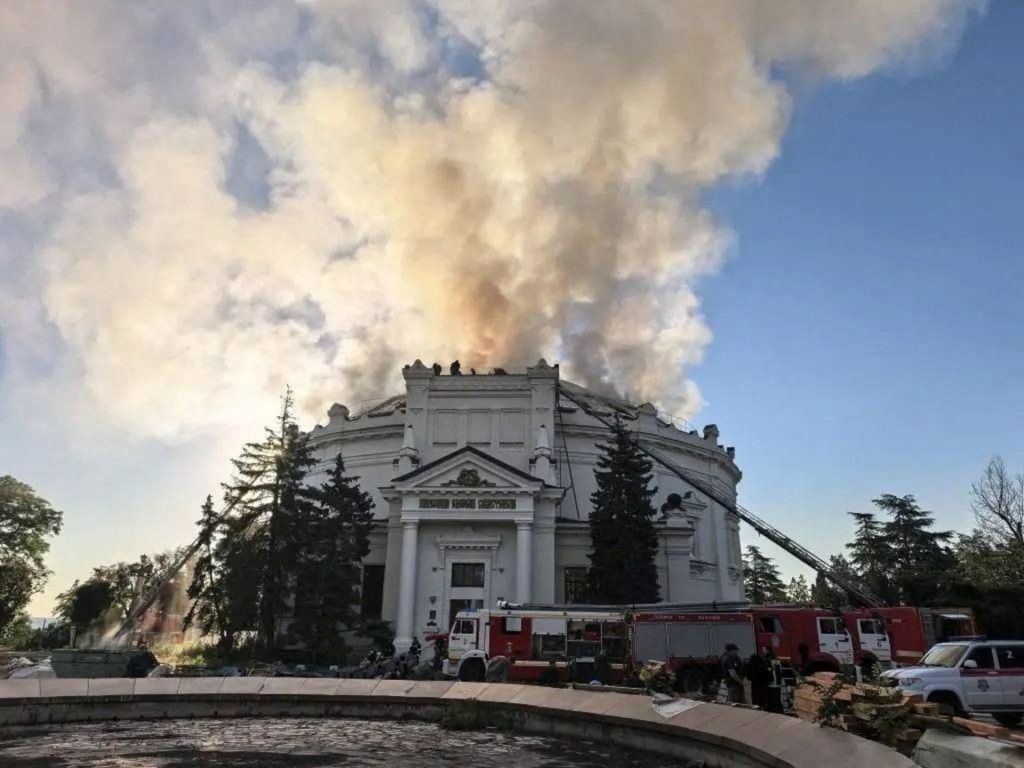
Ukrainian drones struck a historic museum in Sevastopol, Crimea, triggering a fire on the building’s roof, as Russian authorities reduced overnight train services amid escalating aerial attacks across the peninsula and deep inside Russian territory.
The attack was reported early Wednesday by Sevastopol’s Russian-installed governor, Mikhail Razvozhayev, who said on Telegram that the strike caused damage to the museum and sparked a rooftop blaze.
“The UAV damaged the Panorama Museum of the Defence of Sevastopol 1854–1855, causing a fire on the roof,” Razvozhayev said. “This building is not merely a museum; it is a symbol of resilience that has repeatedly withstood enemy attacks.”
The museum houses a monumental panoramic artwork commemorating the defence of Sevastopol during the 1853–1856 Crimean War, when Russia fought a coalition that included the Ottoman Empire, Britain and France.


Drawing parallels with past conflicts, Razvozhayev noted that the museum building was heavily bombed by German forces during the Second World War siege of Sevastopol. Condemning the latest strike, he vowed that those responsible would be held accountable, describing the attack as an act of “sacrilege”.
Emergency responders from Russia’s Emergency Ministry and the Sevastopol Rescue Service were dispatched to the scene and successfully extinguished the blaze, according to Russian media reports.
The latest attack comes as authorities in Crimea scaled back overnight train services following a separate drone strike on Monday that wounded a locomotive driver and killed his assistant.
Crimea’s Russian-appointed governor, Sergei Aksyonov, said on Telegram that the drone struck the locomotive of passenger train No. 68 travelling from Moscow to Simferopol.
“The assistant locomotive driver was killed and the locomotive driver was wounded. Passengers were not injured,” Aksyonov said.


The incident disrupted rail operations across the peninsula, with eight passenger trains temporarily halted. Authorities evacuated all affected passengers by bus and transported them to Simferopol and Sevastopol while railway services were being restored.
Russia’s Defence Ministry said overnight that its air defence systems intercepted and destroyed 326 Ukrainian drones across multiple regions, including more than a dozen that were reportedly heading towards Moscow.
In Novokuibyshevsk, part of Russia’s Samara region and a key oil-refining hub hosting facilities owned by Rosneft, regional authorities said drone attacks had been repelled and urged residents to take shelter. Local officials issued alerts affecting nearly one million people in the area.
Meanwhile, the Russian open-source intelligence (OSINT) channel Astra reported that the Kuibyshevsk oil refinery caught fire after being targeted by at least 29 drones.
In the southern Rostov region, which borders Ukraine, authorities said falling drone debris ignited a fuel storage tank at a civilian facility. Further north, in the Vladimir region, two industrial sites were reported to be on fire following the overnight attacks.
Air raid alerts were also issued in several regions rarely affected by such warnings, including the oil-producing territories of Khanty-Mansiysk, Perm and Tyumen, as well as the industrial Ural regions of Chelyabinsk and Sverdlovsk.
The latest escalation comes amid stalled diplomatic efforts to end the conflict. Last week, Ukrainian President Volodymyr Zelenskyy proposed direct face-to-face talks with Russian President Vladimir Putin, a proposal that Moscow rejected.
Following the train attack in Crimea, the Kremlin accused Ukraine of undermining prospects for a peaceful settlement, arguing that such actions were incompatible with ongoing efforts to find a diplomatic resolution to the war.
-Observer
Invest or Donate towards HICGI New Agency Global Media Establishment – Watch video here
Email: editorial@hicginewsagency.com TalkBusiness@hicginewsagency.com WhatsApp +256713137566
Follow us on all social media, type “HICGI News Agency” .

