
Updated by Faith Barbara N Ruhinda at 1100 EAT on Friday 3 July 2026
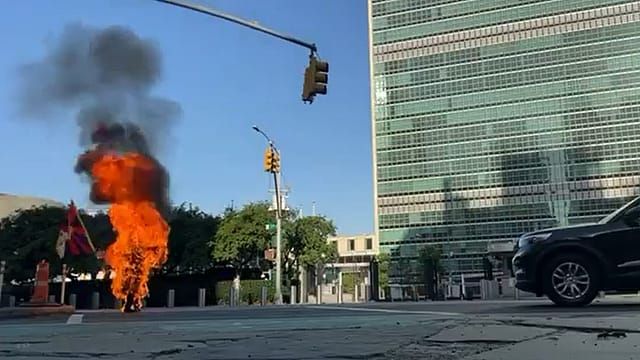
A man has died after setting himself on fire while holding a Tibetan flag outside the United Nations headquarters in New York, according to police.
The New York Police Department (NYPD) said officers responding to an emergency call at approximately 6:30 p.m. local time (2230 GMT) on Thursday found the 52-year-old man suffering from severe burns over much of his body.
He was rushed to hospital in critical condition, where he was later pronounced dead, police said.
Authorities have not yet released the man’s identity or disclosed a possible motive for the self-immolation. An investigation into the incident is ongoing.


The man was rushed to a nearby hospital, where he was later pronounced dead, police said, adding that investigations into the incident are ongoing.
In a statement to AFP, a spokesperson for UN Secretary-General António Guterres expressed sympathy over the incident.
“We are saddened by this tragic and horrific incident, and offer our condolences to his family,” the spokesperson said.
Several US media outlets and a pro-Tibet advocacy group identified the man as a Tibetan activist. However, police have neither confirmed his identity nor disclosed a possible motive for the self-immolation.
Tencho Gyatso, president of the International Campaign for Tibet, identified the deceased as Lobga Rangzen, describing him as a dedicated campaigner for Tibetan rights.
“Lobga was a tireless advocate for Tibet who devoted himself to peacefully raising awareness of the human rights crisis in Tibet,” Gyatso said in a statement.
According to Gyatso, Rangzen had been outspoken in his criticism of China’s new Law on Promoting Ethnic Unity and Progress, which Beijing says is intended to foster a shared national identity among the country’s ethnic groups.
However, overseas rights groups argue that the legislation could further erode the rights of ethnic minorities, including Tibetans and Uyghurs, who have long alleged persecution by the Chinese government.
The United States and the European Union have also voiced concerns over the law, warning that it provides Beijing with a legal basis to extend its actions beyond its borders.


According to the International Campaign for Tibet, more than 150 Tibetans self-immolated between 2009 and 2022 in protest against Chinese rule in Tibet.
China sent troops into Tibet in 1950, asserting that the Himalayan region has been an integral part of its territory for more than seven centuries.
Beijing’s governance of Tibet has long drawn criticism from international human rights organisations and Tibetan exile groups, which accuse the Chinese government of widespread repression and restrictions on religious, cultural and political freedoms. China has consistently rejected those allegations, insisting its policies have improved development and stability in the region.
The Dalai Lama, the 90-year-old Tibetan spiritual leader, has lived in exile in India since fleeing the Tibetan capital, Lhasa, after Chinese forces suppressed a failed uprising in 1959.
China does not recognise Tibet’s government-in-exile, the Central Tibetan Administration, and has not held formal talks with representatives of the Dalai Lama since 2010.
For decades, the Dalai Lama has advocated the “Middle Way” approach, which calls for genuine autonomy for Tibet within China through non-violence, dialogue and mutual benefit, rather than outright independence.
-Aljazeera
Invest or Donate towards HICGI New Agency Global Media Establishment – Watch video here
Email: editorial@hicginewsagency.com TalkBusiness@hicginewsagency.com WhatsApp +256713137566
Follow us on all social media, type “HICGI News Agency” .
 HICGI News Agency