
Updated by Faith Barbara N Ruhinda at 1642 EAT on Wednesday 16 September 2026
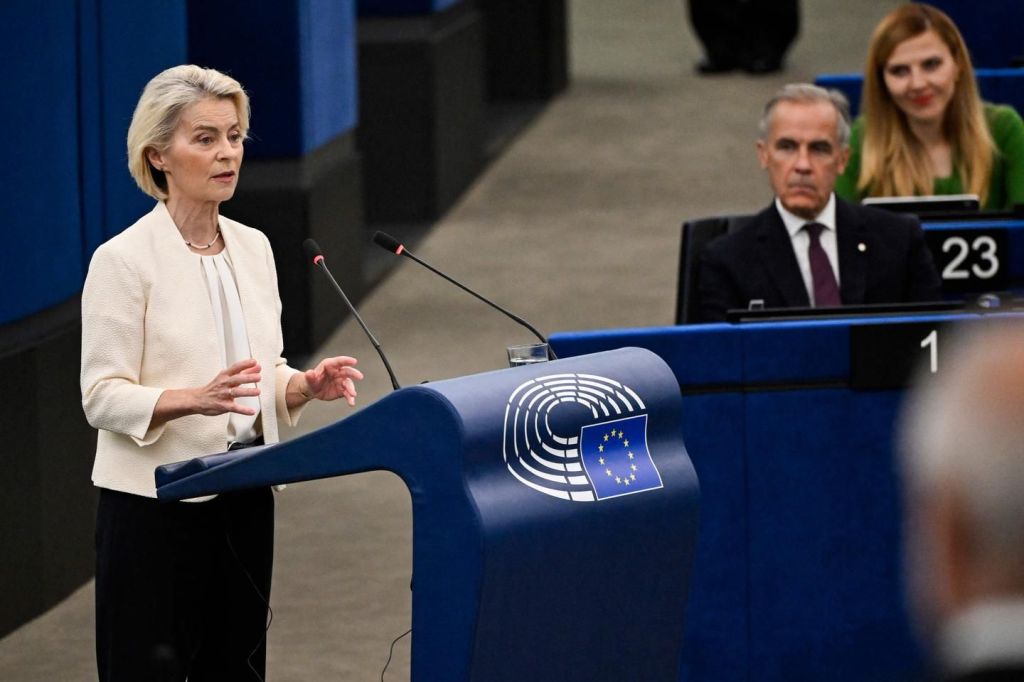
European Commission President Ursula von der Leyen told the European Parliament on Wednesday that she wanted to work on “opening the door” to Canada, potentially paving the way for closer cooperation across several key sectors.
Canadian Prime Minister Mark Carney last week said Canada was seeking a “unique alliance” with the European Union. The move comes as Canada faces strained relations with the United States, amid an intensifying trade dispute.
Without naming US President Donald Trump, von der Leyen said closer ties with Canada would not be “a partnership against anyone else, but for our common strength.”
“Partnerships are a strategic choice for Europe. But they also respond to the fracture in the international rules-based system,” she said.
Carney attended the annual keynote address in Strasbourg and is scheduled to address the European Parliament on Thursday.
Von der Leyen said during the EU’s State of the Union address that the bloc and Canada “see the world with the same eyes” on issues ranging from artificial intelligence and climate change to geopolitics.


“And we have stood together: on Ukraine, on defence, on raw materials and on supply chains. But above all… Europe and Canada believe in democracy,” she said.
She did not provide specific details on how any form of Canadian membership would work, but identified manufacturing, technology, artificial intelligence, defence, energy, critical minerals and economic security as key areas for closer cooperation.
Von der Leyen and other European leaders have found a reliable ally in Carney as they navigate a range of shared challenges.
In particular, Canada and EU member states have faced tensions over US President Donald Trump’s use of tariffs and his threat to annex Greenland, a sovereign territory of EU member Denmark.
However, “associate membership” of the EU does not currently exist, and establishing such a status, if agreed, could take years.
Earlier this year, German Chancellor Friedrich Merz suggested that Ukraine could be granted a similar status, a proposal that drew mixed reactions.
Several Western Balkan countries, including Albania, Bosnia and Herzegovina, Montenegro, North Macedonia and Serbia, are already on the path towards full EU membership.
In Eastern Europe, Georgia and Moldova are also seeking to join the bloc.
The proposal was initially conceived by France and Germany, but more countries have since expressed support, particularly as US President Donald Trump has questioned the NATO military alliance. Other countries, however, fear such a council could unnecessarily rival NATO.
Von der Leyen said the EU was “strengthening our work with NATO” and that increased defence spending would be “fully aligned” with the alliance.
At the heart of the proposed security council would be the ability to trigger an emergency meeting if a member state felt under threat, similar to NATO’s Article 4 mechanism.
The EU chief described it as a “mechanism to flank” Article 4, a phrase that could be interpreted as either complementing NATO’s functions or, in a military context, operating around them.
Alongside global security threats, von der Leyen said many European families were also concerned about the cost of living and the “dizzying speed of change” in technology and its impact on jobs and society.


Other proposals included inviting the world’s leading artificial intelligence (AI) laboratories for talks on supporting industry efforts to advance the technology responsibly, alongside plans to reduce bureaucracy for businesses across the EU.
Von der Leyen also proposed measures to curb social media use among children, including a ban on access to social media platforms for those under 13. Under the proposal, children aged 13 to 15 would only be allowed to create social media accounts with parental supervision.
The EU also plans to introduce a new emergency mechanism to help member states respond more effectively to large-scale migration movements, following the deadly influx of migrants to the Spanish enclave of Ceuta in July.
The proposal aligns with calls from right-wing and far-right European politicians who have gained support in recent years by advocating tougher migration policies.
Some described the mass attempt to enter the EU through Ceuta as an “invasion” and called for asylum rules to be suspended in response to such crises.
-BBC
Invest or Donate towards HICGI New Agency Global Media Establishment – Watch video here
Email: editorial@hicginewsagency.com TalkBusiness@hicginewsagency.com WhatsApp +256713137566
Follow us on all social media, type “HICGI News Agency” .

