
By Dr. Kivumbi Earnest Benjamin, L. H. D (Hon.) – Updated at 1359 EAT on Friday September 24, 2026
BIR LEHLU, — President of the Sahrawi Arab Democratic Republic (SADR) and Secretary-General of the Polisario Front, Brahim Ghali, has formally accepted an invitation from Ugandan President and Chairperson of the African Peer Review Mechanism (APRM), Yoweri Kaguta Museveni, for the Sahrawi Republic to accede to the continental governance mechanism.
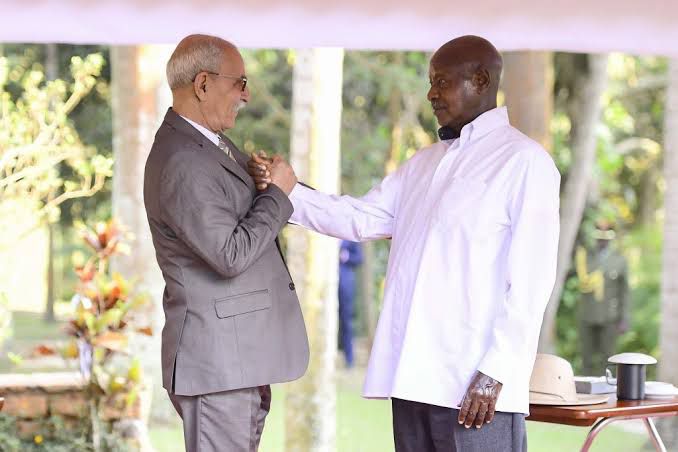
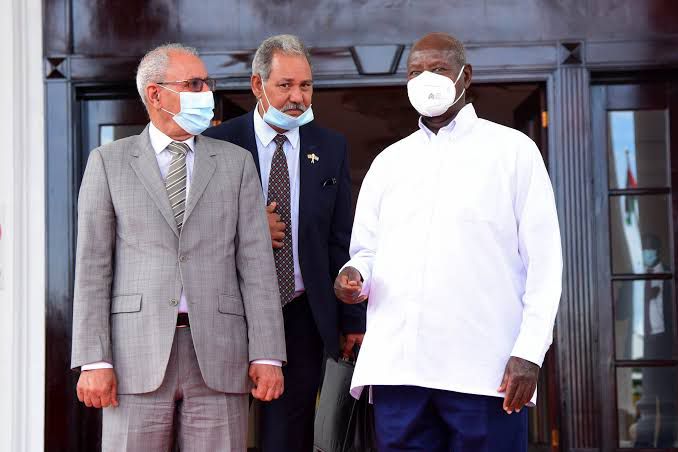
According to the Sahrawi Press Service (SPS), President Ghali communicated the decision in a letter addressed to President Museveni on September 16, 2026. The invitation had originally been extended on July 8.
In the letter, Ghali conveyed the acceptance on behalf of the government and people of the Sahrawi Republic and expressed appreciation for the invitation.
Ghali welcomes Uganda’s leadership of APRM.
President Ghali also commended President Museveni’s leadership of the APRM and highlighted what he described as the Sahrawi Republic’s shared commitment to good governance, transparency, political stability and sustainable socio-economic development across Africa.

Ghali said the Sahrawi Republic considers the APRM an important continental framework for advancing the objectives of “The Africa We Want,” particularly through solidarity, mutual accountability and self-assessment.
He further stated that joining the mechanism would reaffirm the Sahrawi Republic’s commitment to the principles and values contained in the Constitutive Act of the African Union, while expressing readiness to work with President Museveni, the APRM Secretariat and other participating states.
The announcement comes as Uganda holds the chairmanship of the APR Forum, the highest decision-making body of the APRM. The APRM’s official website identifies President Museveni as Chairperson of the APR Forum.
What is the African Peer Review Mechanism?
The African Peer Review Mechanism (APRM) is an African Union mechanism through which participating countries voluntarily assess and review their governance and development practices.
It was established in 2003 by the New Partnership for Africa’s Development (NEPAD) Heads of State and Government Implementation Committee as a voluntary instrument for African states to monitor and improve governance performance.

The mechanism is designed around an African-led process of self-assessment, peer learning and peer review. Countries that voluntarily accede to the APRM agree to subject their governance systems and practices to assessment against agreed African and international standards.
How the APRM works.
The process involves consultations and assessments at national level before a country undergoes a peer review involving participating African Heads of State and Government.
The APRM’s official information identifies several governance areas covered by its assessment framework, including:
Democracy and political governance
Economic governance and management
Corporate governance
Socio-economic development
State resilience to shocks and disasters
E-governance
African Peer Review Mechanism (APRM)
Following a country review, recommendations can be incorporated into a National Programme of Action, allowing the country to address issues identified during the assessment and monitor implementation over time. The African Union says country review reports are subsequently made public following consideration by the APR Forum.
An African-owned governance initiative
The APRM describes itself as an African-owned and African-led platform for governance assessment, peer learning and experience sharing. Its stated purpose is to encourage policies and practices that contribute to political stability, economic growth, sustainable development and greater regional and continental integration.
The APR Forum consists of the Heads of State and Government of AU member states that have voluntarily joined the mechanism. It is the APRM’s highest decision-making authority and is responsible for oversight of the review process, consideration of country review reports and constructive peer dialogue.
African Peer Review Mechanism (APRM)
The APRM has also expanded its role beyond traditional governance assessments. Its official FAQ states that in 2017 the African Union expanded the mechanism’s mandate to include monitoring and evaluation of Agenda 2063 and the UN Sustainable Development Goals (SDGs).
African Peer Review Mechanism (APRM)
SADR’s prospective participation
The acceptance communicated by President Ghali marks a new development in the relationship between the Sahrawi Republic and the APRM. According to the SPS report, the Sahrawi Republic intends to work with the APRM Secretariat, President Museveni and other participating member states to contribute to the mechanism’s objectives
The APRM’s stated philosophy is based on voluntary participation, self-assessment, peer review, mutual learning and accountability, rather than an external assessment imposed on member states.

