
Updated by Faith Barbara N Ruhinda at 1556 EAT on Monday 1 June 2026
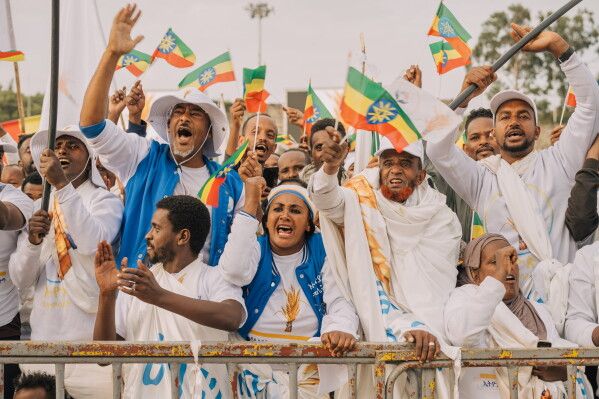
Millions of Ethiopians began casting their ballots on Monday in parliamentary and regional elections, with Prime Minister Abiy Ahmed’s ruling Prosperity Party widely expected to secure a commanding victory despite ongoing security and political challenges across parts of the country.
More than 50 million voters are registered to participate in the polls. However, voting is not taking place in the northern Tigray region, where the National Election Board of Ethiopia (NEBE) said conditions remain unsuitable following the devastating civil war that lasted from 2020 to 2022 and continuing political tensions in the area.
The elections are being held against a backdrop of persistent unrest in several regions, raising concerns among observers about inclusivity and the broader political environment under which the vote is taking place.
At 49, Prime Minister Abiy Ahmed is seeking to further strengthen his hold on Ethiopian politics. He assumed office in 2018 following the resignation of former Prime Minister Hailemariam Desalegn amid widespread anti-government protests that challenged the dominance of the long-ruling Ethiopian People’s Revolutionary Democratic Front (EPRDF) coalition.


Abiy’s ruling Prosperity Party secured a sweeping victory in the 2021 general elections, winning 410 of the 484 parliamentary seats contested, and is widely expected to maintain its dominance in the latest polls.
During the campaign, Prosperity Party candidates highlighted the government’s economic achievements, pointing to improvements in food security and sustained economic expansion in Africa’s second-most populous nation. Ethiopian authorities project economic growth of more than 10 percent in 2026, a rate that would rank among the highest on the continent.
The election also takes place in a country with a remarkably young population, with nearly half of Ethiopia’s estimated 135 million citizens under the age of 18.
Despite his political dominance, Abiy continues to grapple with armed insurgencies in two of Ethiopia’s largest regions, driven by longstanding grievances among some ethnic groups over what they describe as marginalisation within the country’s federal system.
In the Oromia region, Ethiopia’s most populous state, clashes between government forces and the Oromo Liberation Army (OLA) have persisted for years, claiming hundreds of lives and contributing to ongoing instability. The conflict remains one of the most significant security challenges facing the government as the country heads into the elections.
In neighbouring Amhara region, the Fano militia has gained control of large parts of the countryside since 2023, creating significant security challenges. As a result, voting will not be conducted in at least eight of the region’s 138 constituencies.
Although a peace agreement signed in 2022 formally ended the devastating war in Tigray — a conflict that researchers estimate claimed hundreds of thousands of lives — concerns over renewed instability persist. Tensions have risen following a move by the region’s dominant political force last month to reassert control over Tigray’s political administration, prompting warnings from Ethiopian officials and analysts about the potential for fresh unrest.
Despite the security and political challenges facing several parts of the country, Abiy Ahmed’s ruling Prosperity Party is widely expected to secure another decisive victory. The fragmented opposition, weakened by internal divisions and rivalries, is seen as unlikely to mount a significant challenge.
Official election results are expected to be announced by June 11.
Since taking office in 2018, Prime Minister Abiy Ahmed initially pursued sweeping political and economic reforms, including liberalising Ethiopia’s tightly controlled economy and releasing journalists, activists, and other political prisoners. He was awarded the Nobel Peace Prize in 2019 for his role in ending the long-standing hostilities between Ethiopia and neighbouring Eritrea.
However, critics, including opposition figures and human rights groups, say those early gains have since been reversed. They accuse the government of detaining journalists, restricting civil society organisations, and overseeing military operations in various regions that have been marked by serious allegations of human rights abuses.


The Ethiopian government has consistently rejected accusations of systematic violations, arguing that its actions are necessary to maintain national unity and safeguard security amid ongoing internal conflicts.
Relations with Eritrea, once significantly improved under the 2018 peace accord, have also deteriorated in recent years. Tensions have been fuelled in part by repeated remarks from Abiy asserting Ethiopia’s need for access to the sea, comments that Eritrea — which gained independence from Ethiopia in 1993 — has interpreted as implying a potential threat to its sovereignty.
-Aljazeera
Invest or Donate towards HICGI New Agency Global Media Establishment – Watch video here
Email: editorial@hicginewsagency.com TalkBusiness@hicginewsagency.com WhatsApp +256713137566
Follow us on all social media, type “HICGI News Agency” .
 HICGI News Agency