
Updated by Faith Barbarav N Ruhinda at 1205 EAT in Wednesday 12 June 2026
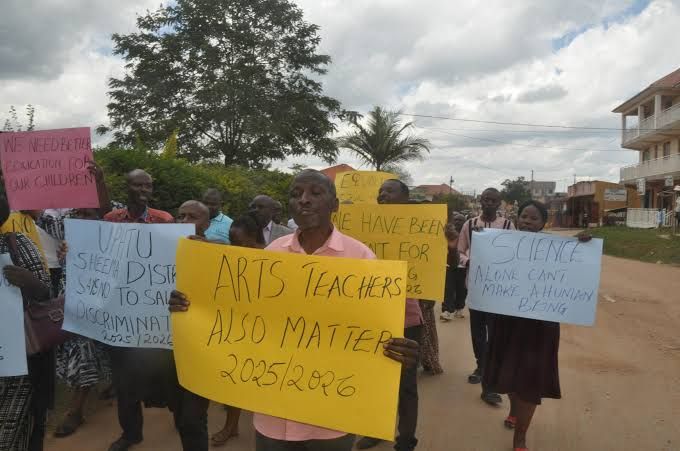
The government has significantly increased funding for education, skills development and sports in the 2026/27 financial year, with part of the additional allocation earmarked for a long-awaited salary enhancement for arts and primary school teachers.
According to the budget speech presented by Finance Minister Henry Musasizi, the sector has been allocated more than Shs 6.66 trillion, up from Shs 5.04 trillion in the previous financial year.
The allocation accounts for 7.82 per cent of the projected national budget of Shs 84.4 trillion, compared to 6.97 per cent of last year’s Shs 72.376 trillion budget.
A key component of the increased funding is a 25 per cent salary enhancement for arts and primary school teachers, which will take effect in the 2026/27 financial year.

Under the revised pay structure, the minimum monthly salary for primary school teachers will rise from Shs 499,684 to Shs 624,605. Secondary school arts teachers holding bachelor’s degrees will see their salaries increase from Shs 960,288 to Shs 1,200,360 per month, while diploma holders will earn Shs 931,250, up from Shs 745,000.
The salary adjustment is expected to address long-standing concerns over disparities in teacher remuneration and improve motivation among educators across the country.
Finance Minister Henry Musasizi said the government has allocated an additional Shs 568.65 billion to fund the salary enhancement for teachers.
“Beginning FY 2026/27, an additional Shs 568.65 billion has been allocated to enhance salaries for primary school teachers and arts teachers in secondary schools and BTVET institutions,” Musasizi said while presenting the national budget.
The salary adjustment will benefit more than 155,000 teachers and marks the first phase of a broader Shs 2.5 trillion programme aimed at addressing pay disparities that emerged after science teachers received substantial salary increases in the 2022/23 financial year.
The reforms are also aligned with the National Teacher Policy (2019) and the human capital development objectives outlined in the Fourth National Development Plan (NDP IV).
Beyond salary enhancements, the education sector allocation will support five key priorities: expanding access to quality Universal Primary Education (UPE) and Universal Secondary Education (USE); strengthening Science, Technology, Engineering and Mathematics (STEM) education and vocational training; improving teacher welfare and professional development; implementing curriculum reforms; and supporting public universities and research institutions.
Part of the funding will also be directed towards completing sports infrastructure projects ahead of the 2027 Africa Cup of Nations (AFCON), which Uganda will co-host alongside Kenya and Tanzania.
The government also plans to recruit additional teachers to address staffing shortages across the country. Michael Aliyo, the Commissioner for Planning at the Ministry of Education and Sports, told Parliament’s Education Committee in April that the ministry intends to recruit 3,000 teachers, including 1,842 science teachers and 1,158 arts teachers.
The recruitment drive is expected to ease staffing gaps, particularly in newly established seed secondary schools, many of which continue to operate with inadequate teaching personnel.


The Uganda National Teachers’ Union (UNATU) has welcomed the salary enhancement, describing it as a significant step towards improving teacher welfare and addressing longstanding concerns over pay inequalities within the profession.
Uganda National Teachers’ Union (UNATU) National Chairperson Zadock Tumuhimbise welcomed the salary enhancement but urged the government to honour its commitment by implementing future pay adjustments progressively in line with agreed plans.
He, however, noted that non-teaching staff, who play an equally vital role in supporting the education sector, were excluded from the latest salary increment and should be considered in future reviews.
Despite the increased budget allocation, Uganda’s spending on education remains below both regional and international benchmarks. The country currently invests about 2.7 per cent of its Gross Domestic Product (GDP) in education, significantly lower than the East African average of 4.2 per cent and UNESCO’s recommended range of between 4 and 6 per cent.
According to data from the 2019/20 Uganda National Household Survey, households continue to shoulder a substantial share of education costs. For every Shs 1,000 spent by the government on primary education, households contribute approximately Shs 1,450.
Meanwhile, the Uganda Human Capital Development and Growth Review Report 2025 paints a stark picture of an education system under strain, citing overcrowded classrooms, low teacher remuneration, heavy workloads, poor learning outcomes and widening inequalities in access to quality education.
The report, jointly produced by the government and the World Bank, warns that meeting the country’s future education needs will require sustained and substantial investment.
It projects that by 2040, Uganda will need to increase education spending by 440 per cent, recruit an additional 360,000 teachers, more than double its current classroom capacity and expand textbook availability nearly fourfold to meet growing demand and improve learning outcomes.
Invest or Donate towards HICGI New Agency Global Media Establishment – Watch video here
Email: editorial@hicginewsagency.com TalkBusiness@hicginewsagency.com WhatsApp +256713137566
Follow us on all social media, type “HICGI News Agency” .

