
Updated by Faith Barbara N Ruhinda at 1259 EAT on Tuesday 8 September 2026
Forces loyal to Yemen’s internationally recognised government have launched counterattacks against Houthi rebels, with officials saying they aim to recapture the capital, Sanaa, from the Iran-backed group.
Fighting intensified on Monday in the provinces of Taiz, Al Bayda and Al Jawf, which is considered a key gateway to the capital. Government forces, backed by Saudi Arabia, said they had carried out rocket and drone strikes on Houthi positions and reported “intensive battles” involving ground troops.
The Houthis said they had repelled an offensive in Al Jawf and claimed that at least seven people were killed in an airstrike on a prison in the town of Al Hazm. They blamed Riyadh for the attack, warning that the “aggression will not go unpunished.”
Saudi Arabia, meanwhile, accused the Houthis of wounding at least 73 civilians, including women and children, in recent attacks on the kingdom’s southern provinces.
Riyadh also vowed to respond to what it described as a “dangerous escalation.”
Amid escalating tensions, Yemen’s Deputy Defence Minister, Major-General Samir Al-Sabri, said in remarks broadcast on state television that the government had decided to “retake Sanaa.”
Majid Al-Nuzaili, a spokesman for Yemen’s government-aligned forces, said the objective of the campaign was to “liberate Yemen from the grip” of the Houthis and “restore Sanaa as a capital for all Yemenis.”


He also warned civilians to avoid several major roads leading to Sanaa, saying the alert applies to routes connecting the capital with Marib and Al Jawf, including roads passing through Nihm, Sirwah and Mahliyah.
The hostilities mark the most serious escalation since a United Nations-brokered truce halted large-scale fighting in 2022.
Yemen’s war began in 2014 after the Houthis seized control of Sanaa, prompting a Saudi-led military intervention the following year. Diplomats had hoped the truce would pave the way for a lasting political settlement, but those efforts have stalled amid wider regional tensions triggered by the United States and Israel’s war against Iran.
Fighting resumed in July when government forces struck the Houthi-controlled airport in Sanaa, preventing an Iranian aircraft from landing. Last week, the Houthis launched a major offensive, attempting to advance through western Taiz and southern Hodeidah towards the port city of Al Mokha and the Bab al-Mandeb Strait in the Red Sea.
The Houthis had declared a blockade on Saudi vessels transiting the waterway, a vital shipping corridor linking the Red Sea and the Gulf of Aden. The strait has gained further strategic importance for Saudi oil exports since Iran began restricting passage through the Strait of Hormuz at the start of the US-Israeli war against Iran.
Ahmed Al-Shalafi, Al Jazeera’s Yemen affairs editor, said government forces appeared “to have absorbed the initial shock” of the Houthi offensive and had “expanded the fighting across several fronts, partly to stretch Houthi forces and increase pressure on them.”
He said the fighting had initially been concentrated west of Taiz and south of Hodeidah, but had since spread to the provinces of Al Dhale, Marib, Al Jawf and Al Bayda.


“Al Jawf is particularly important because it borders Saudi Arabia and connects towards Saada province, the Houthis’ main stronghold,” he said. “Al Bayda is strategically significant because it lies at the centre of Yemen and connects eight governorates – four in the north and four in the south.”
The World Health Organization (WHO) said on Monday that at least 728 people had been killed or wounded since August 23, with the majority of casualties reported in Taiz and along Yemen’s western coast.
The WHO also estimated that about 21,000 people — or roughly 3,000 families — had been displaced from Taiz alone since Thursday.
Al Jazeera’s Yousef Mawry, reporting from Sanaa, said the casualty figures were expected to rise further because they did not include casualties recorded on Monday.
“These casualties are said to be in the hundreds from both sides, especially as we have reports of air strikes being conducted in the governorate of Al Jawf,” he said.
Earlier, government-aligned forces announced a ground offensive towards the Al Labanat Mountains in Al Jawf and claimed to have carried out rocket attacks on Yatma in the same province. The forces’ media centre said their troops were also “engaged in intensive battles” with the Houthis in the area.
The forces added that their troops had advanced to the outskirts of Dhi Na’im District in Al Bayda.
The Houthis, however, said they had repelled the large-scale advance towards the Al Labanat Mountains.
In a post on X, Mohammed Al-Farah, a member of the Houthi political bureau, claimed that dozens of government-aligned fighters had been killed or wounded. He also said Houthi forces had targeted reinforcements in Al Jawf with several ballistic missiles.
According to Al-Farah, the strikes destroyed or damaged dozens of military and armoured vehicles, with several commanders reportedly among those killed or wounded.
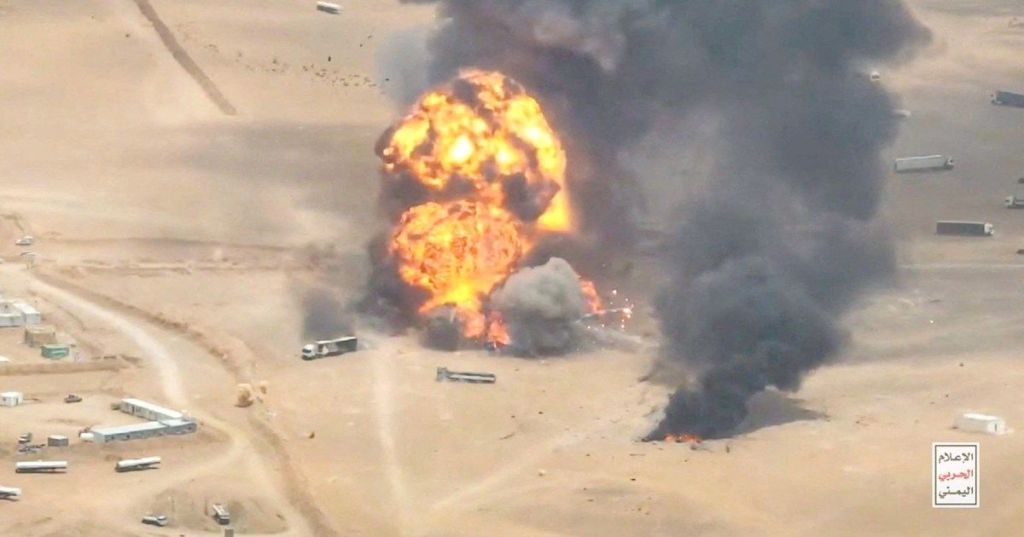
Earlier, the Houthis also released footage they said showed a ballistic missile striking trucks carrying military equipment from Saudi Arabia at Al Wadiah camp in southeastern Hadramawt.
Saudi Arabia did not immediately comment on the Houthi claim.
Al Jazeera could not independently verify the battlefield claims made by either the Houthis or the Yemeni government.
-Aljazeera
Invest or Donate towards HICGI New Agency Global Media Establishment – Watch video here
Email: editorial@hicginewsagency.com TalkBusiness@hicginewsagency.com WhatsApp +256713137566
Follow us on all social media, type “HICGI News Agency” .

